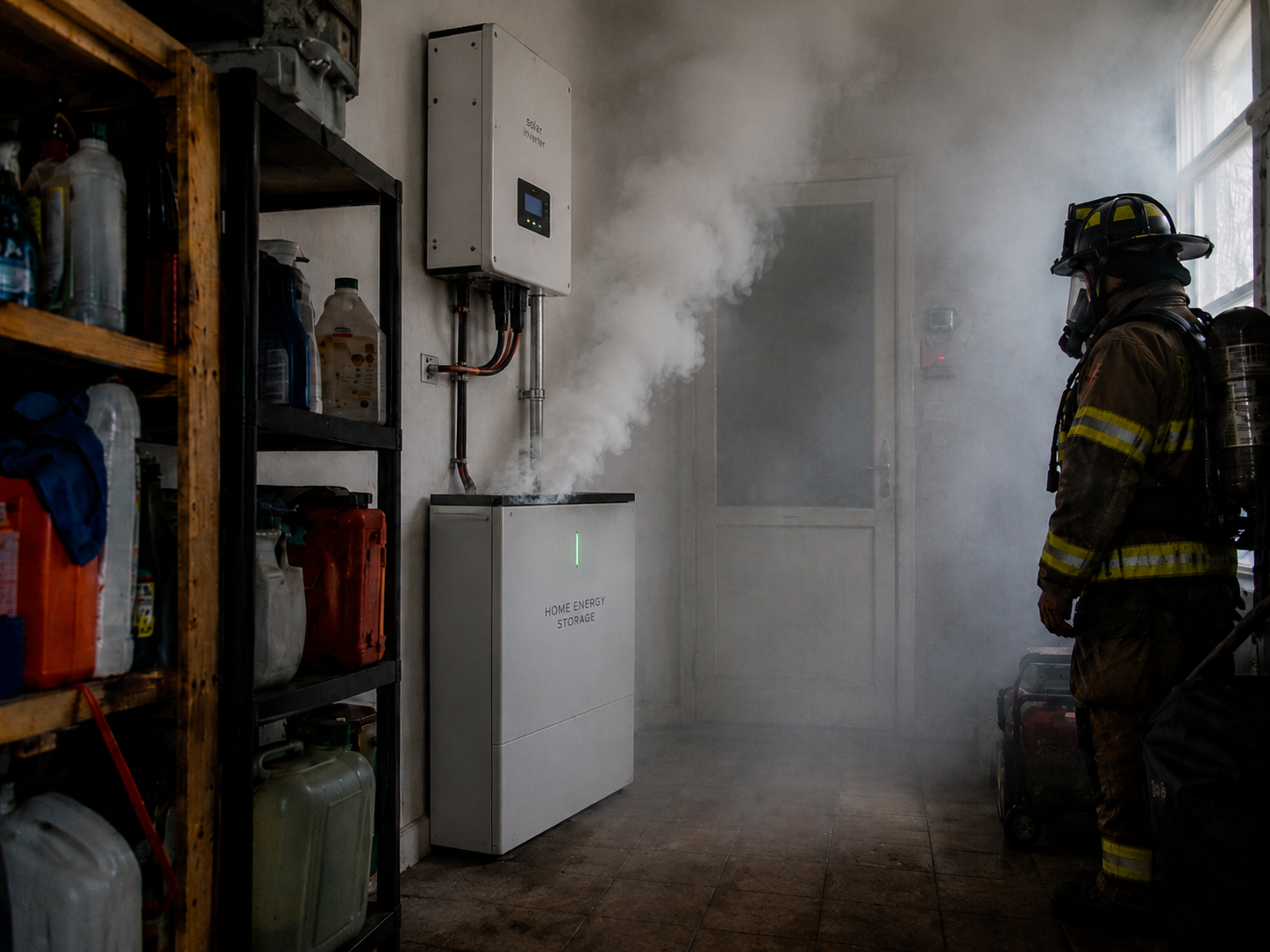
The Fire Academy puts Li-ion battery safety on the Polish research agenda
The Fire University of Warsaw (Akademia Pożarnicza) included two lectures dedicated to lithium-ion battery safety in its conference *"Safety Engineering: Origins, Challenges, Perspectives"*:
- "Lithium-ion battery safety – hazards and challenges" by Dr Wojciech Mrozik, Newcastle University.
- "Early detection of cell decomposition – a key element of the safety system for traction battery storage" by Senior Brigadier Dr Eng. Małgorzata Majder-Łopatka, Fire University.
> Conclusion: Li-ion safety is now part of Poland's scientific, firefighting and engineering debate.
Newcastle University and Dr Wojciech Mrozik: why gases matter
Dr Mrozik works on Li-ion battery safety and environmental impact within the SafeBatt project led by the Faraday Institution. His tests of extreme failure scenarios — such as overcharging a small residential ESS — record gas composition and volume, internal and ambient temperatures, voltage drop, and video of the failure progression.
Modern battery safety research no longer asks only "did it ignite?". It analyses the full event chain: first signs of decomposition → gas emission → potential ignition, explosion or propagation to neighbouring cells.
> Research shows: When a Li-ion battery fails, the critical questions are not just about flames but about which gases form, how much accumulates, where they collect, and whether they can create a flammable or explosive atmosphere.
Vapour cloud explosion — the battery gas-cloud blast
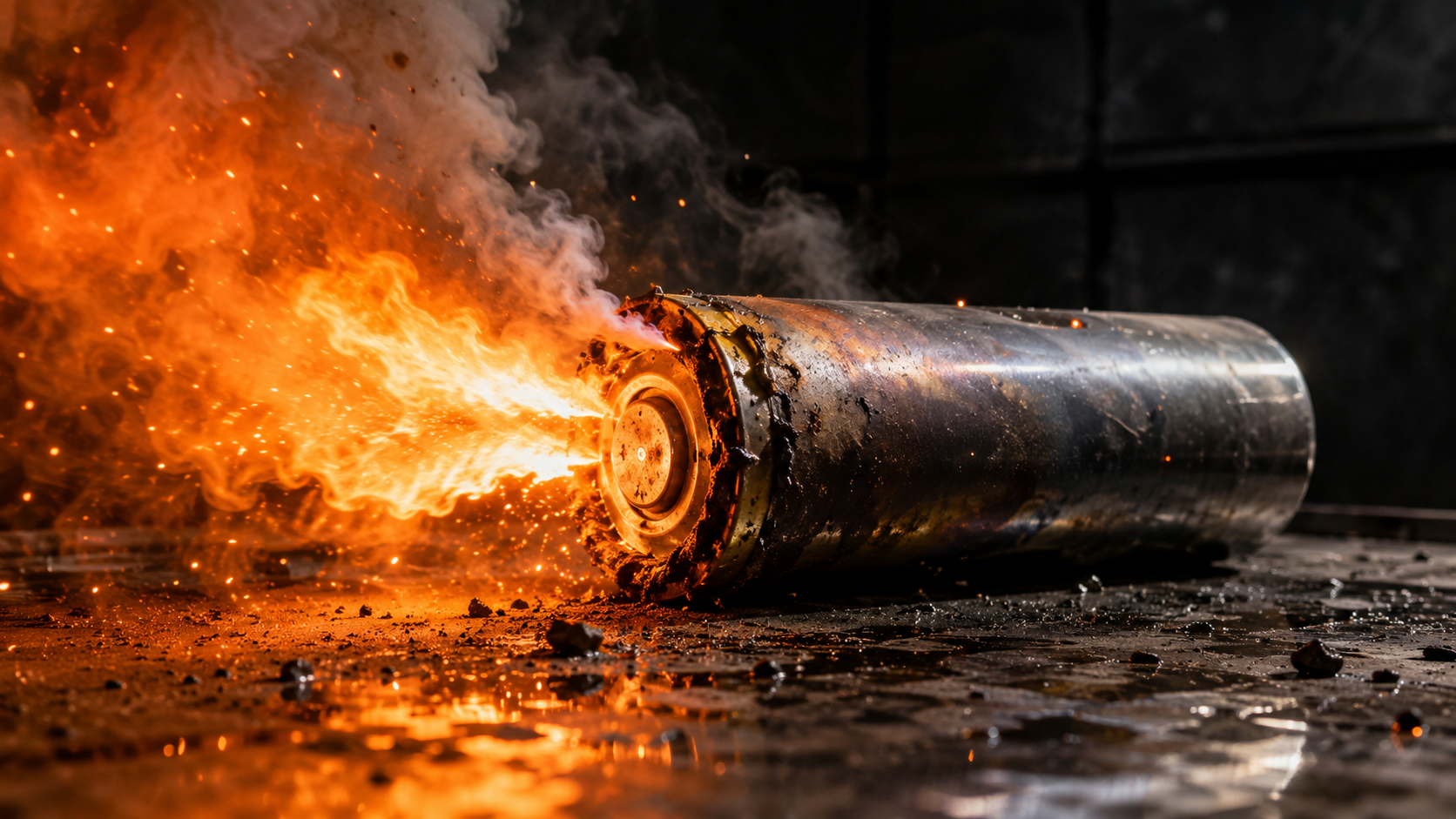
A key contribution of Prof. Paul Christensen (Newcastle University) is highlighting the hazard called vapour cloud explosion. According to the Faraday Institution, in 2020 Christensen's team drew attention to a previously underrecognised risk: during thermal runaway — triggered by overheating, crushing or overcharging — a cell can release a cloud of gases containing hydrogen, CO, CO₂ and fine droplets of organic electrolyte solvents (DMC, EMC, EC).
Emergency services may previously have mistaken such clouds for water vapour or ordinary smoke. Their chemical composition, however, creates a real risk of a vapour-cloud explosion that can be more destructive than the initial fire.
> Key conclusion: If a Li-ion battery vents flammable or explosive gases, the protection design cannot stop at extinguishing the flame. It must also include safe gas evacuation, prevention of accumulation, and protection of people nearby.
Why this matters for fire services, designers and users
Li-ion hazards are layered: thermal runaway → gas release → toxic, flammable or explosive cloud → potential re-ignition after the visible flame is suppressed. Designers therefore need to combine gas and temperature detection, directional venting, ventilation, propagation control and physical separation of the battery from people and buildings.
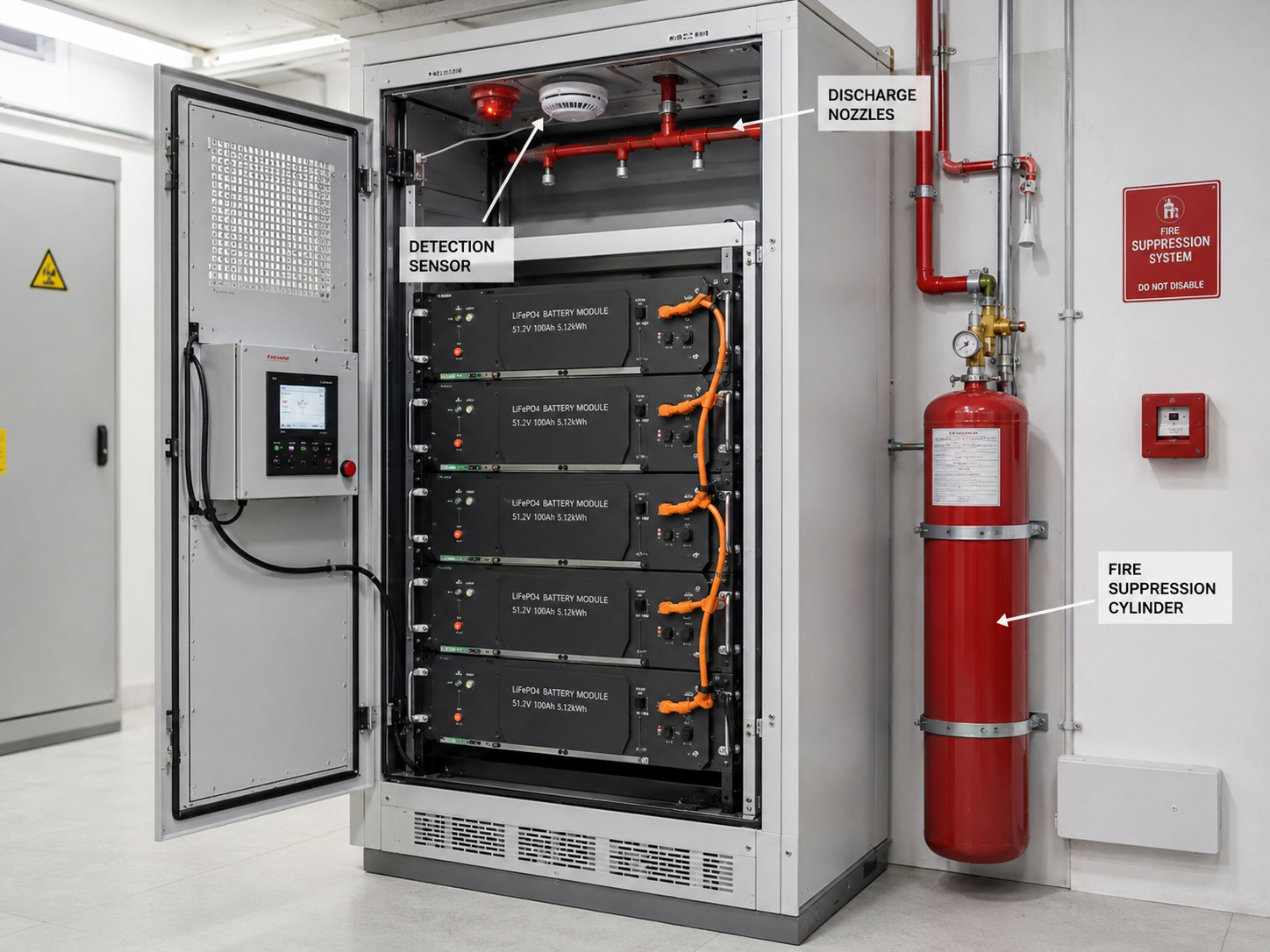
> In practice: Li-ion safety must be layered — BMS, detection, temperature monitoring, non-combustible enclosure, separation, controlled venting and emergency procedures should work together.
Early decomposition detection — the Polish research direction
The lecture by Dr Eng. Małgorzata Majder-Łopatka points to a fundamental direction: battery safety should start before the fire. The Fire University student group DeteCtor also runs a project titled *"Monitoring of exothermic decomposition of Li-ion cells as a tool for early hazard identification"*. The earlier a system detects an anomaly, the better the chance of limiting the consequences.
Suppression is necessary — but not sufficient
The doctoral thesis of Natalia Kraus-Namroży (Fire University, Warsaw, 2024), *"Analysis of the effectiveness of low-pressure water mist with a DMS nozzle in suppressing Li-ion battery fires"*, confirms that low-pressure water mist effectively limits fire spread, including in larger LIB assemblies. But cooling alone does not close the case.
In the Fire Technology / Springer paper *"Performance of Extinguishing Agents against Lithium-Ion Battery Fires"* (Mrozik, Christensen et al.), tests on an 8 kWh residential ESS showed that no tested agent fully prevented propagation or saved the system. The authors flagged a critical issue: vapour and gas production was linked to cooling effectiveness, increasing the importance of vapour/gas-management strategies.
What this means for ESS, e-scooters and tool batteries
The topic applies to home LiFePO₄ ESS, NMC packs in e-scooters and e-bikes, tool batteries, charging points, service shops, waste battery storage and collection bins. Even with the more thermally stable LFP chemistry, the full system — BMS, wiring, connectors, enclosure, charger, operating conditions — still generates risk. Protection must be layered.
Implications for PassivX
A battery safety enclosure is neither a "simple box" nor a "magic suppression system". Its core function is to limit the consequences of failure. In line with the cited research, key functions are:
- separation of battery from people and building,
- containment of fire spread,
- reduction of heat impact on surroundings,
- controlled gas venting,
- optional flame arrestors,
- temperature monitoring,
- optional gas/VOC detection,
- prevention of flammable-gas accumulation,
- additional reaction time for users and responders,
- integration with a professional fire-safety design.
FAQ
Can battery gases be more dangerous than the flame? Yes, according to Newcastle University and Faraday Institution research. Does the Polish Fire University address Li-ion safety? Yes — it is on the conference agenda. What is a vapour cloud explosion? A blast of a gas cloud released during a battery failure. Is suppressing the flame enough? Not always; gases, re-ignition and propagation must be managed. Is LiFePO₄ fully safe? More thermally stable than NMC, but not risk-free at system level. Is PassivX a suppression system? No — it is a containment and separation enclosure, designed to work alongside detection and suppression systems.
Sources
1. Fire University of Warsaw — conference *"Safety Engineering"*: apoz.edu.pl 2. Fire University — DeteCtor student group: apoz.edu.pl 3. Faraday Institution — *Improving the Safety of Li-ion Battery Cells*, Insight 17, 2023: PDF 4. Faraday Institution — Wojciech Mrozik profile: faraday.ac.uk 5. Fire Technology / Springer — *Performance of Extinguishing Agents against Li-ion Battery Fires*: link.springer.com 6. Fire University Library — Kraus-Namroży thesis (2024): biblioteka.apoz.edu.pl