What is thermal runaway?
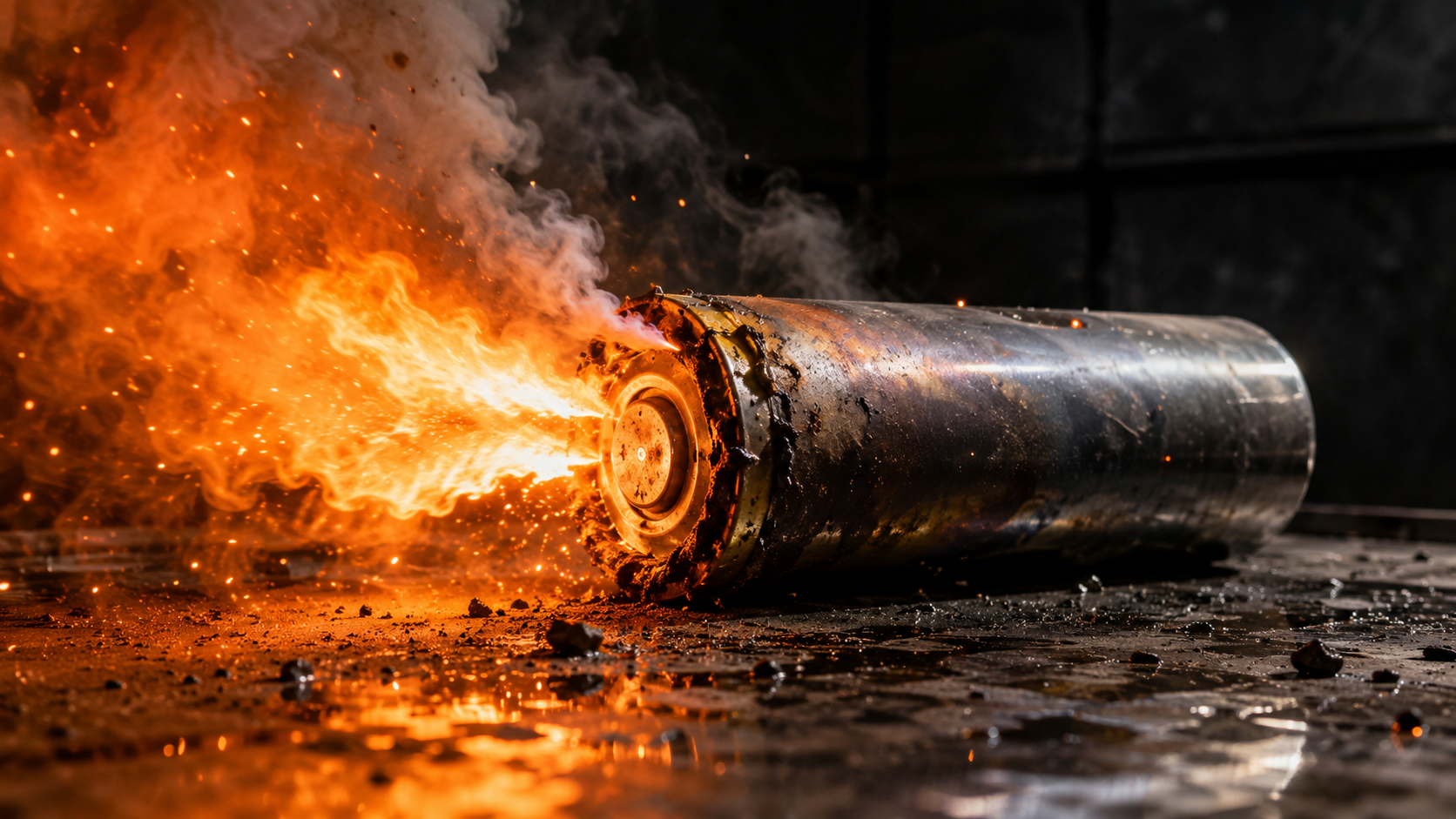
Thermal runaway is a phenomenon where a lithium cell enters a self-sustaining exothermic reaction. Temperature rises exponentially — from 80 °C to over 800 °C in tens of seconds — and the reaction spreads to neighboring cells (cascading propagation).
Phases of thermal runaway
| Phase | Temperature | What happens |
|---|---|---|
| Phase 1 — overheating | 80–120 °C | SEI layer decomposition, onset of exothermic reactions |
| Phase 2 — separator | 130–150 °C | Separator melting, internal short circuit |
| Phase 3 — runaway | 150–250 °C | Cathode decomposition, rapid oxygen release |
| Phase 4 — fire / explosion | >250 °C | Electrolyte ignition, toxic gas emission (HF, CO, HCN) |
LiFePO4 vs NMC — is LFP "safe"?
LiFePO4 (LFP) is more thermally stable than NMC — thermal runaway starts at higher temperatures (~270 °C vs ~150 °C). But this doesn't mean it's safe:
- LFP can still enter thermal runaway
- Cascading propagation is slower but not excluded
- Emitted gases (including HF) are equally toxic
- LFP fires are difficult to extinguish with standard means
Why BMS is not enough?
BMS (Battery Management System) monitors voltage, current and cell temperature. It can disconnect the circuit — but:
- BMS cannot stop a chemical reaction that has already started
- BMS temperature sensors measure module surface temperature, not inside the cell
- Internal short circuit can occur without prior warning
- BMS is an electrical safeguard, not a fire protection system
Why a fire extinguisher is not enough?
A standard powder or CO₂ extinguisher cannot:
- Lower temperatures inside the cell below the runaway threshold
- Stop an exothermic reaction once started
- Prevent reignition — even after apparent extinguishing
- Neutralize toxic gases released from the electrolyte
The only effective strategy is thermal and mechanical isolation
A fire-resistant external enclosure (e.g., PassivX PX-UNIT) provides:
- EI60 fire resistance — prevents fire spread
- Thermal isolation — keeps external temperature in a safe range
- Building separation — minimizes structural risk
- Evacuation time — provides minimum 60 minutes for emergency response
Summary
Thermal runaway is not a failure you can "fix" with an extinguisher. It's a chemical reaction that must be isolated. BMS systems and extinguishers are important components, but they don't provide passive protection — the kind that works even when everything else fails.
Solution: PassivX fire-resistant enclosure — the only barrier that requires no power, sensors, or human response.