1. The incident
On 5 August 2025, in the morning, Northamptonshire Fire and Rescue Service crews were called to Gayton Marina (Northamptonshire, UK) to a fire that had engulfed the cabin of a canal boat. Moments before crews could begin firefighting, the boat exploded. No serious injuries were reported; the fire was then extinguished. The boat was fitted with a LiFePO₄ (LFP) pack of EV-traction class — large prismatic cells with a total energy of several tens of kWh. The cause of ignition is still under investigation (NFRS, 29 Aug 2025).
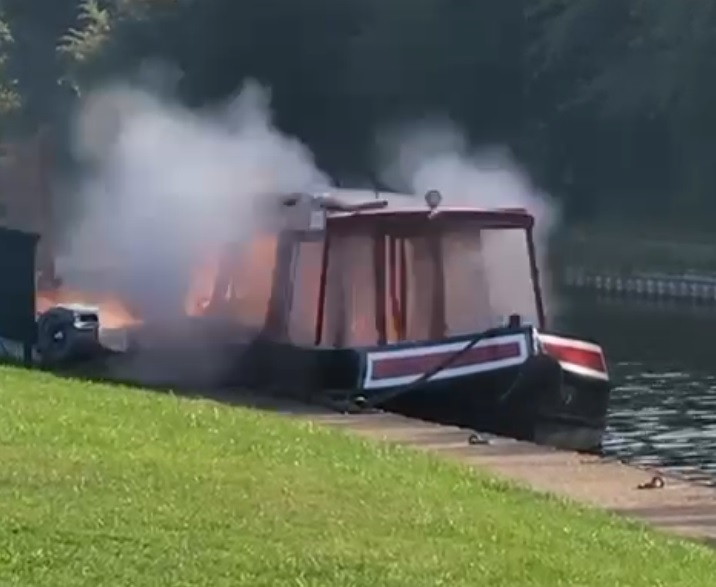
*Photo: Northamptonshire Fire and Rescue Service / northantsfire.gov.uk. Informational/educational use.*
Video from the scene (YouTube):
2. Classification
The fire → pause → violent explosion sequence is the textbook picture of a delayed vent-gas deflagration in a confined space (the boat cabin). EPRI (2024) and DNV-GL (2020) identify three regimes: diffusion fire, deflagration (ΔP 0.1–0.8 bar), and — under strong confinement and high H₂ content — detonation (ΔP > 1 bar, front speed > 1000 m/s). Hull damage and roof ejection suggest strong deflagration approaching detonation in a cabin acting as a pressure vessel.
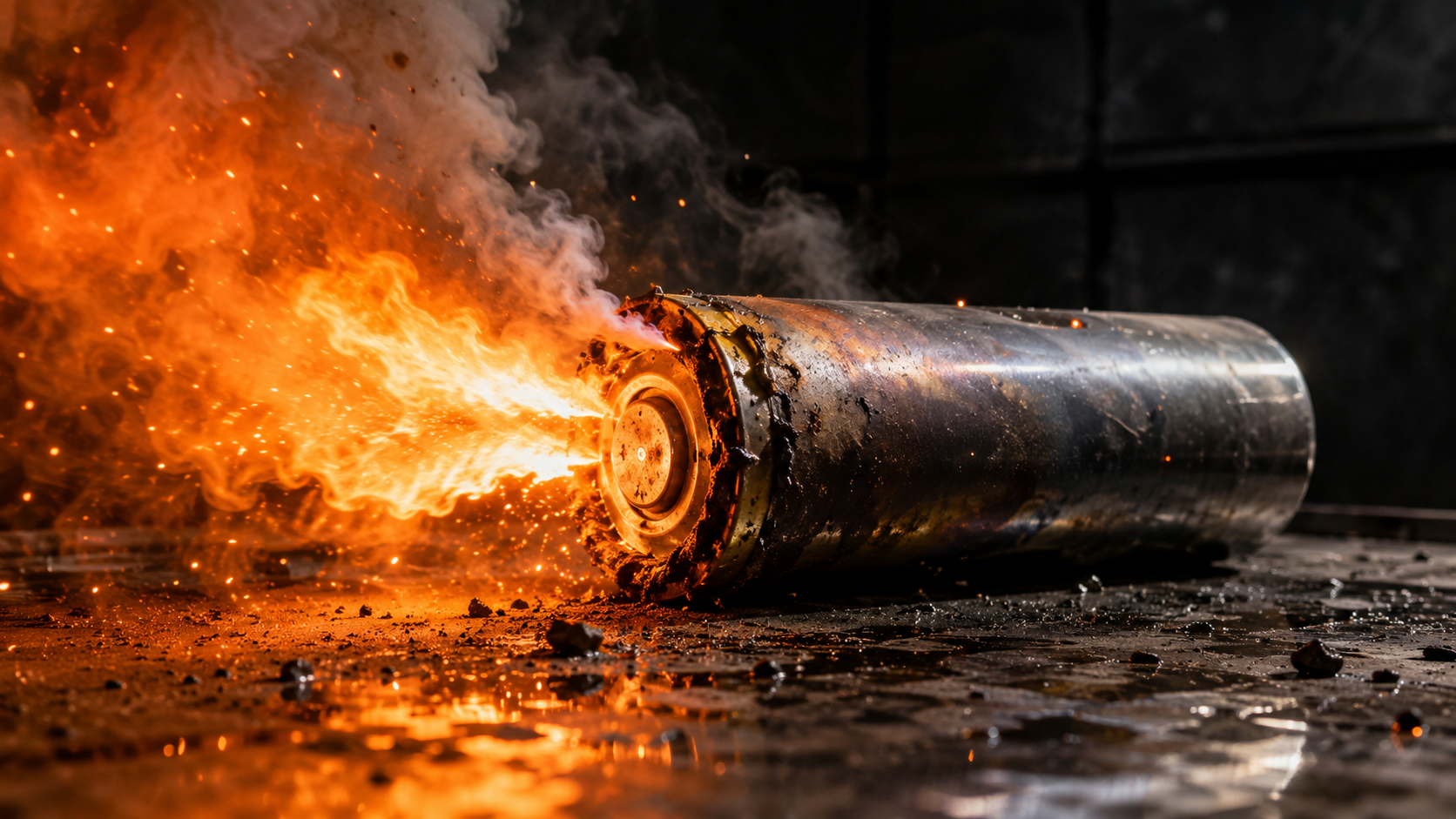
A second mechanism specific to EV-grade packs is a cell-level BLEVE (Boiling Liquid Expanding Vapour Explosion): rapid vaporisation of electrolyte (DMC/EMC/EC, b.p. 90–248 °C) in an overheated hermetically sealed prismatic cell, mechanical rupture of the casing, immediate vapour ignition.
3. Mechanism — why the blast was so violent
1. High pack energy (30–80 kWh range for EV/marine variants). The trapped electrolyte and active material are 10–30× greater than in a typical tool battery. 2. Cabin confinement. The steel-and-timber narrowboat cabin behaves as an un-vented pressure vessel — vent gases (H₂ 30–40 %, CO 15–25 %, CH₄ and light hydrocarbons, DMC/EMC vapours) accumulate above the lower explosive limit (LEL ≈ 5–6 vol %). 3. Pre-explosion fire phase. The cabin fire heats remaining cells, propagating thermal runaway through neighbouring modules (5–15 cm/min front per Feng et al. 2018) and generating fresh waves of gas. 4. Volumetric ignition. When the mixture sits in the flammability window (H₂: 4–75 vol %, broadest of any technical fuel), an ignition source (open flame front, DC arc, spark) triggers volumetric deflagration at ΔP 0.3–0.8 bar — enough to tear the hull and eject the roof. 5. Timing of the blast — just before suppression began — is typical: opening doors or hatches changes airflow, lifts oxygen in the fuel-rich zone, and shifts the mixture into the explosive window.
4. Why specifically LiFePO₄ — the "safe chemistry" paradox
LFP has the highest thermal-runaway onset of common chemistries (T_onset 200–250 °C vs. 150–170 °C for NMC; Feng et al. 2018) and releases no cathode oxygen. A single LFP cell burns less, but the explosion risk in confinement is comparable to — and in some respects greater than — NMC:
- Higher H₂ fraction in vent gas (30–40 % vs. 20–30 % for NMC) — H₂ has the widest flammability range and the lowest ignition energy (0.019 mJ).
- Slower, longer gas release before ignition — the pack "silently" vents for minutes to hours, accumulating fuel in the cabin.
- Lower tendency to immediate self-ignition at vent opening — gas disperses, reaches the flammability window away from the source, producing delayed volumetric ignition rather than a local diffusion fire.
- High single-cell thermal stability synchronises runaway across the pack — once threshold is crossed, neighbouring cells trigger near-simultaneously, amplifying the gas surge.
5. Design and operational lessons
| Factor | Gayton Marina | Requirement |
|---|---|---|
| Pack location | inside the living cabin | separate compartment with gravity venting outside |
| Ventilation | not documented, likely natural | forced, vent-gas < 25 % LEL |
| Gas detection | none | H₂ + LEL, alarm ≤ 10 % LEL, automatic DC disconnect |
| Pressure relief | none | dedicated panels per EN 14491 / NFPA 68 |
| Crew procedure | entry without thermal imaging or LEL meter | mandatory 25–50 m exclusion zone for confined LFP fires, LEL monitoring before entry |
| Pack | EV-grade in living space | passive EI60 enclosure with controlled gas release |
6. Recommendation
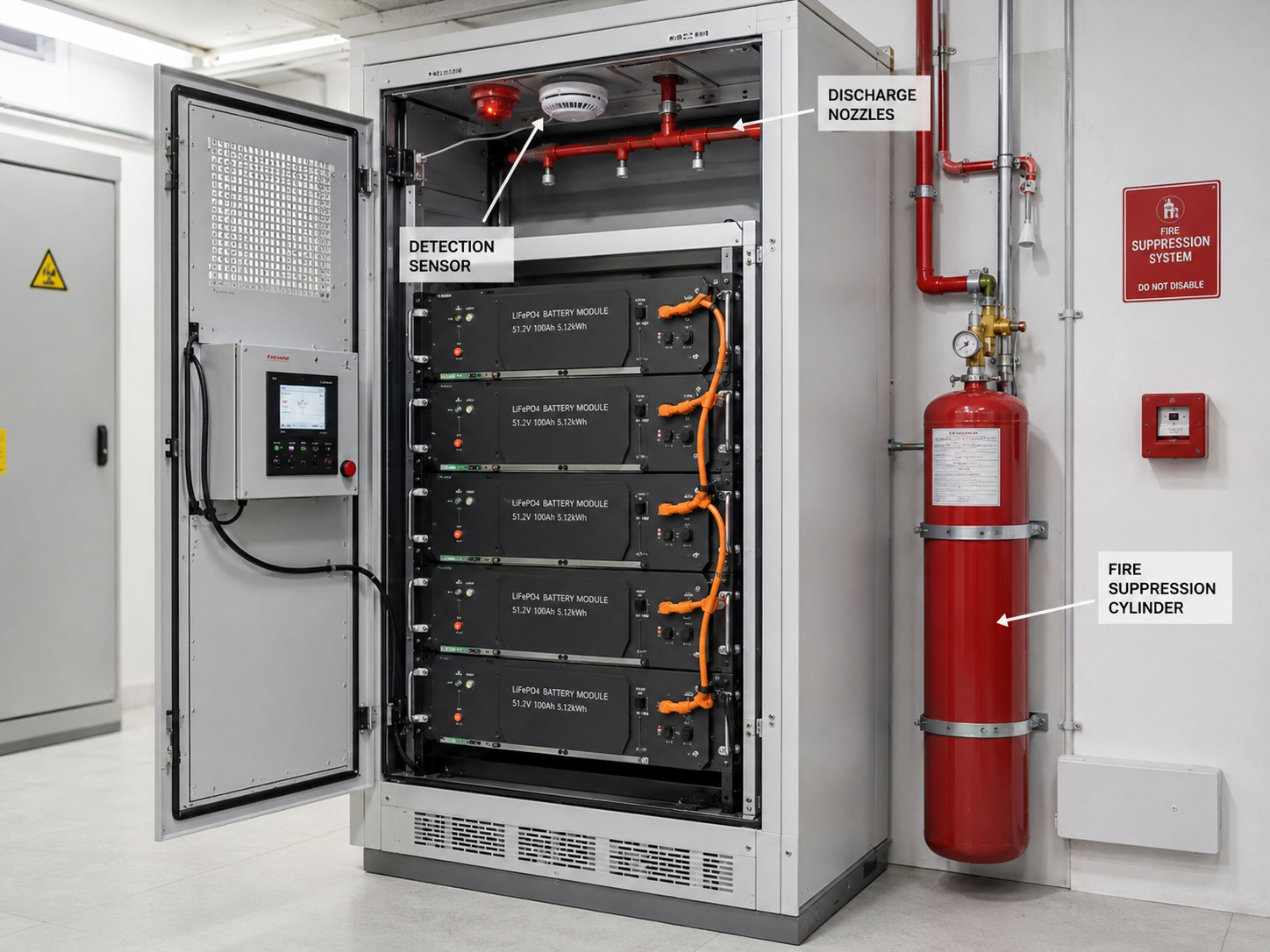
A passive outdoor enclosure with certified fire resistance and controlled gas release (e.g. PassivX) moves both the fire and any deflagration outside the occupied zone, reducing consequences from catastrophic to acceptable.
---
*Gayton Marina facts: Northamptonshire Fire and Rescue Service, statement of 29 Aug 2025 (northantsfire.gov.uk).*