1. The event
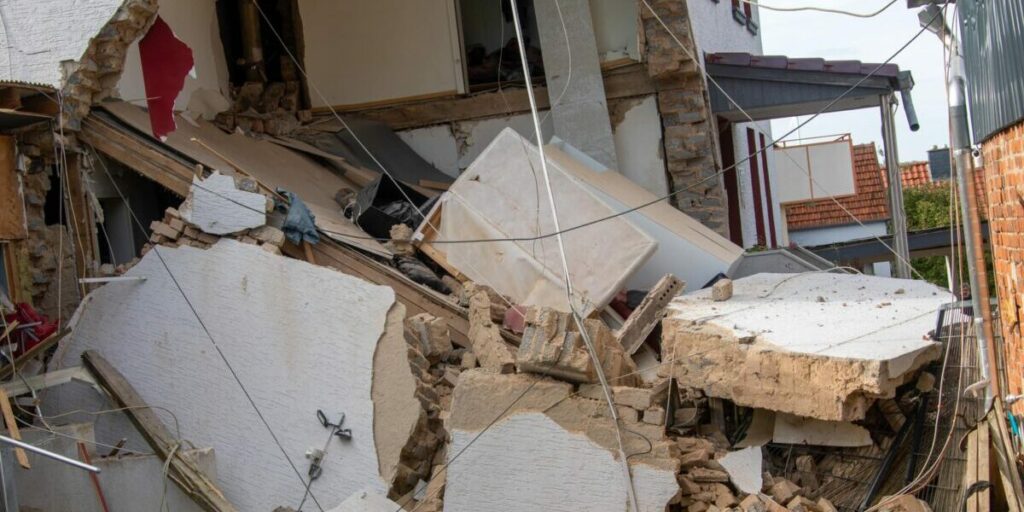
In February 2025 a residential battery storage system installed in a Viebrock-Haus single-family building in Schönberg (Schleswig-Holstein, Germany) detonated, tearing out a load-bearing exterior wall without a sustained compartment fire. Industry reporting (pv-magazine.de, 24 Feb 2025) identifies the unit as an LG RESU home battery manufactured in 2019, installed in 2020 and coupled to the building's PV system. The occupants were abroad at the time. The damage pattern — all four exterior walls affected, structural condemnation, no developed fire — is characteristic of a vapour cloud explosion (VCE), not of conventional combustion.
In response, the house manufacturer placed all units from the same production batch into stand-by and throttled remaining LG high-voltage storage. LG runs an open serial-number-based service action citing overheating risk. Criminal investigation is ongoing.
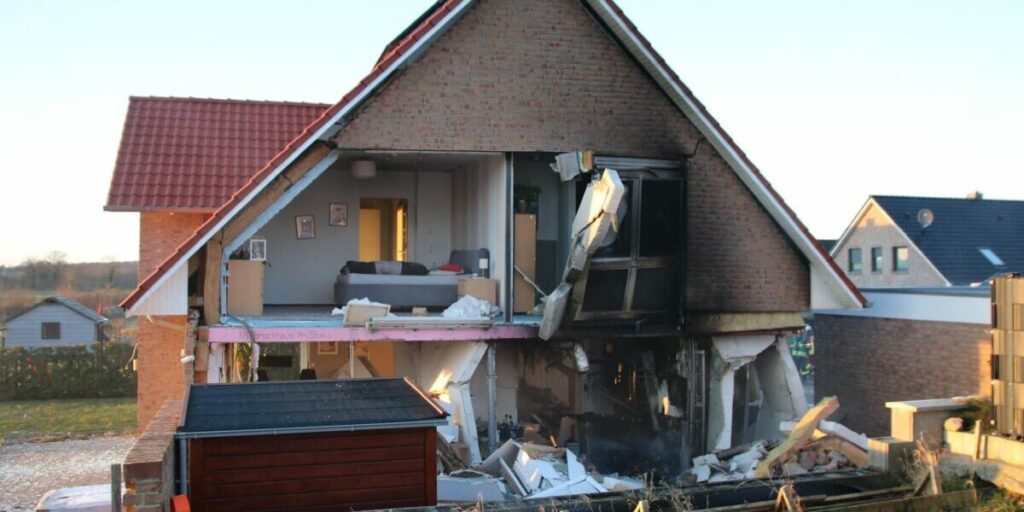
*Photo credit: Freiwillige Feuerwehr Schönberg via trittau-online-magazin.de / pv-magazine.de. Used for informational/educational purposes.*
2. Why explosion rather than fire?
BESS incidents fall into three physical regimes: fire (diffusion combustion, negligible overpressure), deflagration (subsonic premixed combustion, peak overpressure 0.1–0.8 bar — sufficient to destroy masonry), and detonation (supersonic, multi-bar overpressure). Where thermal runaway gases accumulate in a confined room and ignite only after reaching the flammable range, the result is a vapour cloud explosion with minimal post-event fire. This mechanism is documented in the APS McMicken event (Arizona, 2019; DNV-GL 2020 report), where an LFP module runaway was followed by a deflagration injuring four firefighters. The Schönberg damage pattern is consistent with VCE.
3. Li-ion vent-gas composition and flammability
Vent-gas released after cell CID/burst activation is qualitatively similar across chemistries (Bugryniec et al. 2018/2019; Sandia SAND2018-12831; Baird et al. 2020; EPRI BESS Failure Incident Database 2024):
| Component | Vol. share (range) | Key parameters |
|---|---|---|
| H₂ | 20–40 % | LEL 4.0 %, UEL 75.6 %; fast laminar burning velocity |
| CO | 5–25 % | LEL 12.5 %; toxic |
| CH₄, C₂H₆, C₂H₄ | 10–30 % combined | LEL 2.7–5.3 % |
| CO₂ | 10–30 % | inert, delays ignition |
| Carbonate vapours (DMC, EMC, EC) | trace | flash points 18–33 °C |
4. Why LiFePO₄ can also participate in an explosion
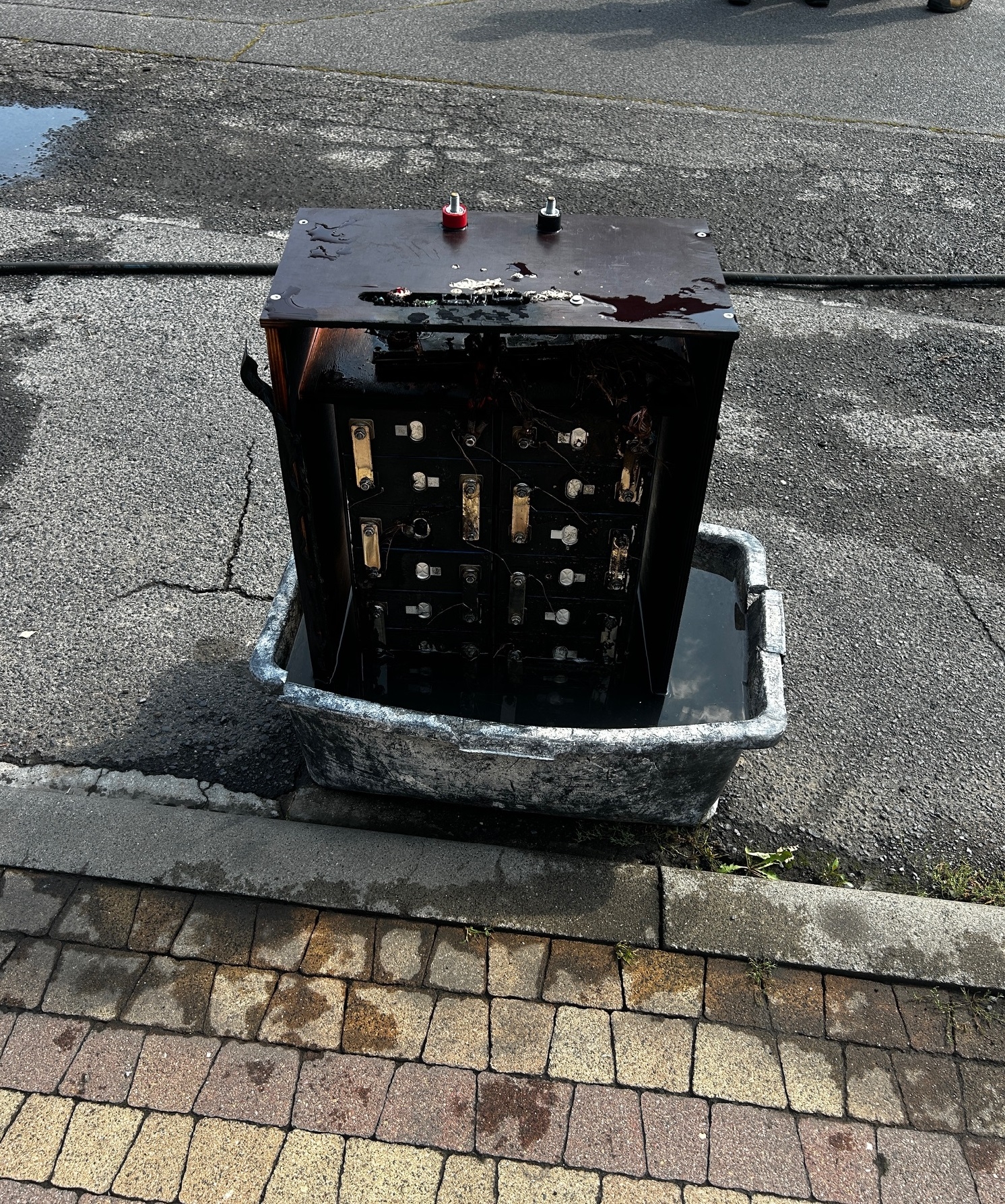
LiFePO₄ has the highest thermal stability among commercial Li-ion chemistries — higher runaway onset (200–250 °C vs. 150–170 °C for NMC, Feng et al. 2018), no cathodic oxygen release at early runaway, no cobalt oxidation. This makes a single LFP cell less prone to sustained fire, but does not exclude it from explosive events, for three chemistry-specific reasons:
(a) LFP releases proportionally more H₂. Experimental work (Bugryniec 2019; Baird 2020; Sandia 2021–2023) shows LFP vent-gas typically contains 30–40 vol % H₂ vs. 20–30 % for NMC, via reduction of residual electrolyte water on the graphite anode (C + H₂O → CO + H₂). H₂ has the widest flammable range and the highest burning velocity of all vent-gas constituents, making LFP-derived mixtures more, not less, prone to deflagration.
(b) LFP outgasses slowly but for longer. LFP runaway is less violent but extends over tens of minutes. In a confined utility room this allows systematic accumulation well above LEL before any visible thermal signature appears. An arc from BMS, inverter or contactor relay then suffices for ignition.
(c) LFP self-ignites less reliably. Paradoxically, the lower autoignition tendency of LFP vent-gas is a risk factor for VCE: NMC vent-gas often ignites locally at the vent (jet fire), continuously consuming the fuel; LFP gas frequently escapes without local ignition, disperses through the compartment, reaches the flammable window, and ignites volumetrically with delay.
These three mechanisms are consistent with APS McMicken 2019 (LFP), Liverpool 2020, Beijing 2021 (LFP) and EPRI BESS Failure Incident Database 2024, where a meaningful share of explosions without sustained fire involved LFP systems.
5. Design implications
Explosion protection requires chemistry-agnostic layers:
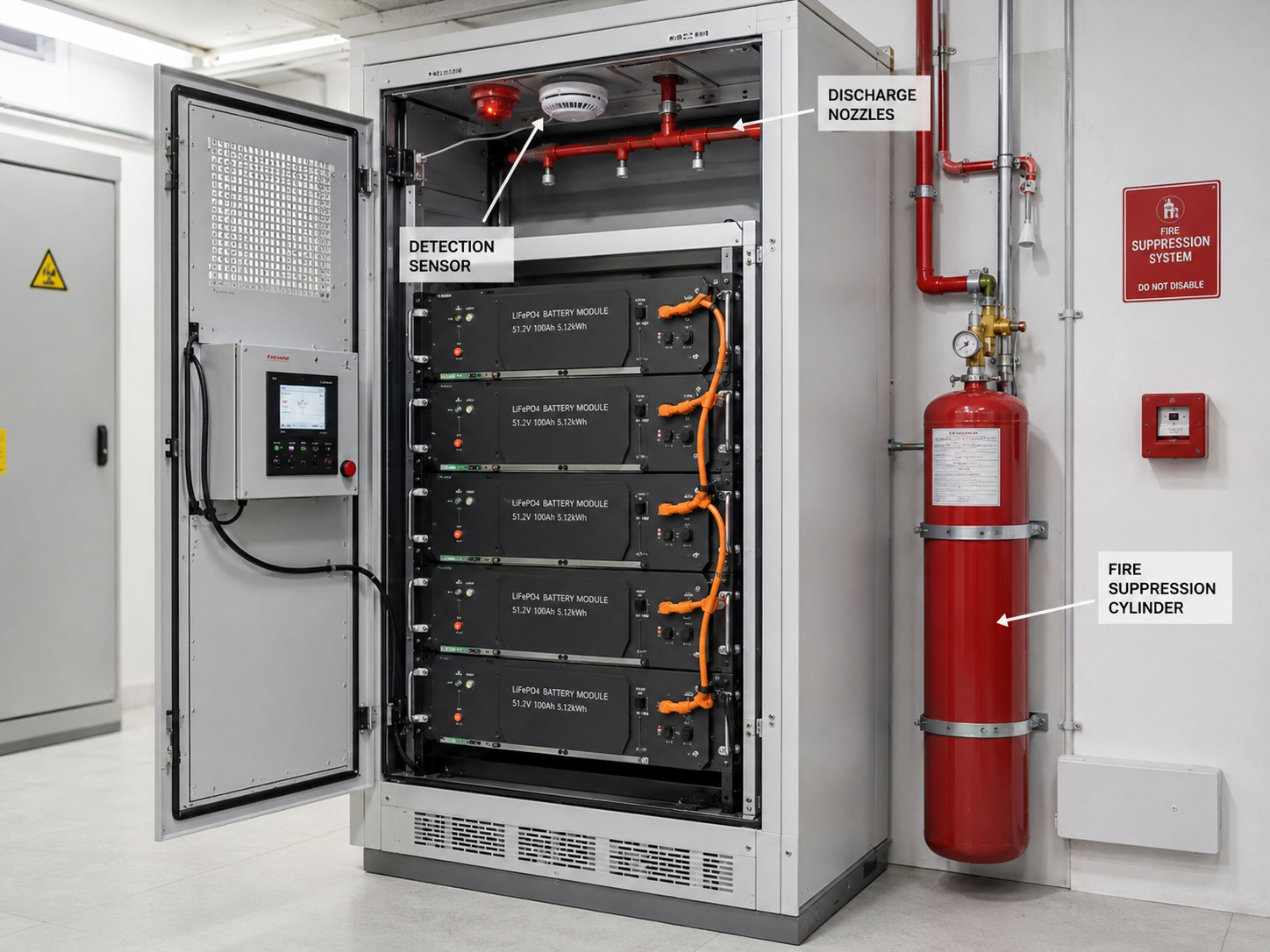
1. Passive gravity venting sized to keep vent-gas below 25 % LEL (NFPA 855, FM Global DS 5-33). 2. H₂ / LEL detection with ≤ 10 % LEL alarm, triggering forced ventilation and DC disconnect. 3. Deflagration-resistant enclosure with relief panels (EN 14491 / NFPA 68) directing the pressure wave away from occupied zones. 4. Outdoor or fire-separated location with at least EI60 separation from living spaces. 5. Physical separation of power electronics from the pack to remove ignition sources near vents.
The colloquial claim that "LFP is safe" is correct only in the narrow sense of higher single-cell thermal stability. For confined-space vent-gas explosion risk, LFP requires the same — in some respects more rigorous — engineering controls as NMC.
6. Role of the protective enclosure
A passive outdoor enclosure (e.g. PassivX) provides the first and cheapest layer of protection: moving the event outside the building envelope. A non-combustible, thermally insulated enclosure with controlled pressure-relief direction limits any deflagration to the unoccupied outdoor zone — regardless of whether the failed module is NMC or LFP.
---
Selected references: Feng et al., *Energy Storage Materials* 2018; Bugryniec et al., *J. Power Sources* 2019; Baird et al., *J. Power Sources* 2020; DNV-GL McMicken Report 2020; EPRI BESS Failure Incident Database 2024; NFPA 855:2023; NFPA 68:2023; EN 14491:2012; Sandia SAND2018-12831 and 2021–2023 updates.
*Schönberg incident facts based on: Sandra Enkhardt, pv-magazine.de, 24 Feb 2025.*