1. The incident
On Friday, 6 October 2023, around 14:00, in the Wernges district of Lauterbach (Hesse, Germany), a 30 kWh home battery energy storage system installed in the basement of a two-family house exploded. According to the Hesse State Police (Polizeipräsidium Osthessen) and the homeowner's statement, the system used LiFePO₄ (LFP) cells — it was neither an LG nor a Senec unit. The initial emergency call reported smoke in the building; arriving firefighters found no open fire, but the eastern external wall had collapsed under explosion overpressure.
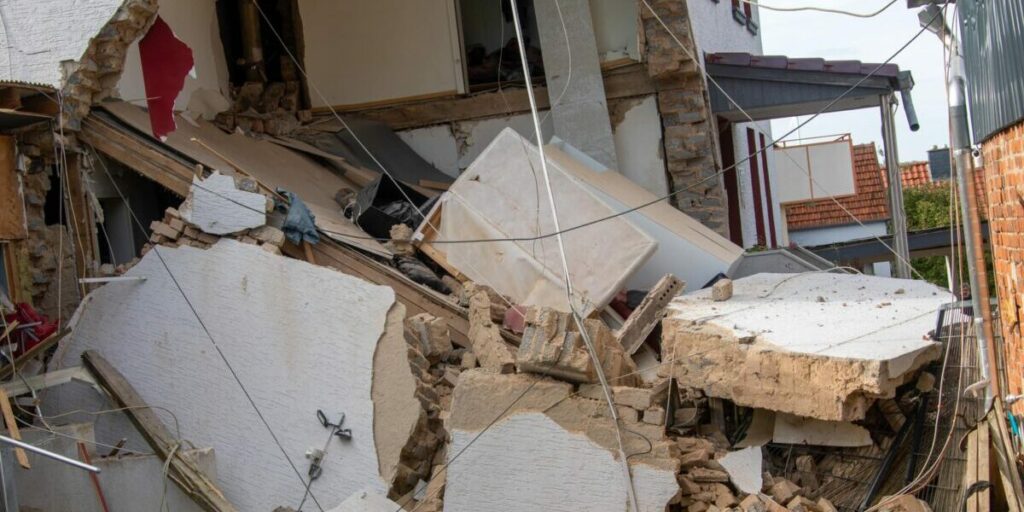
*Photo: Vogelsberger Zeitung / Freiwillige Feuerwehr Lauterbach Löschzug Ost, via pv-magazine.de. Informational/educational use.*
Video footage from the scene (YouTube):
Three people (owner, tenant, neighbour) were lightly injured. The building was declared uninhabitable with damages in the mid-six-figure EUR range. Due to collapse risk, investigators could not enter the basement and the technical cause remained formally unresolved (pv-magazine update, 27 Oct 2023).
2. Classification: deflagration, not fire
The damage pattern — load-bearing wall blown out without a sustained fire — corresponds to a battery vent-gas deflagration, not a classical combustion event. BESS literature (DNV-GL 2020, EPRI 2024) distinguishes three energy regimes:
- diffusion fire — burning at the fuel/air interface, negligible overpressure,
- deflagration — premixed subsonic combustion, ΔP ≈ 0.1–0.8 bar (enough to destroy masonry),
- detonation — supersonic shockwave, several bar.
3. Mechanism: LFP off-gassing in a closed basement
The pv-magazine update of 27 October 2023 explicitly states that cells had most likely undergone off-gassing prior to the explosion. The canonical mechanism (Bugryniec 2019; Baird 2020; Sandia 2018–2023):
1. Initiation — internal short, overcharge or BMS fault triggers exothermic SEI decomposition (> 80 °C), then electrolyte decomposition (> 120 °C). 2. Cell venting — at 10–20 bar internal pressure the LFP prismatic cell safety vent opens and releases H₂, CO, CH₄, C₂H₄, C₂H₆, DMC/EMC/EC vapours plus electrolyte aerosol. 3. Accumulation in confined space — in an unventilated basement, gas density vs. air (H₂ < 1, hydrocarbons > 1) drives stratified accumulation until the mixture reaches the lower explosive limit (LEL ≈ 5–6 vol % for Li-ion vent-gas mixtures). 4. Ignition — a spark from BMS relay, inverter, charge contactor, or a DC-arc on disconnect suffices. 5. Volumetric deflagration — flame front 5–30 m/s, ΔP 0.3–0.5 bar destroys masonry walls.
4. Why LFP — the "safe chemistry" paradox
LFP has the highest thermal runaway onset of commercial Li-ion chemistries (200–250 °C vs. 150–170 °C for NMC; Feng et al. 2018) and releases no cathode oxygen. This makes a single LFP cell less prone to sustained fire — but does not eliminate explosion risk, for three chemistry-specific reasons:
(a) LFP releases proportionally more H₂. Experiments (Bugryniec 2019; Baird 2020; Sandia 2021–2023) show 30–40 vol % H₂ in LFP vent-gas vs. 20–30 % for NMC, via C + H₂O → CO + H₂ on the graphite anode. H₂ has the widest flammable range (4–75 vol %) and the highest burning velocity — making LFP vent-gas more, not less, prone to deflagration.
(b) LFP outgasses slowly but for longer. Runaway less violent, extends over tens of minutes — in a confined basement this allows systematic accumulation well above LEL before any visible thermal signature.
(c) LFP self-ignites less reliably. Paradoxically, the lower autoignition tendency of LFP vent-gas is a VCE risk factor: NMC vent-gas often ignites locally at the vent (jet fire), consuming fuel as it is released; LFP gas escapes without local ignition, disperses through the room, reaches the flammable window, and ignites volumetrically with delay.
Lauterbach fits this pattern: smoke before the explosion = off-gassing; no sustained fire after the explosion = fuel consumed in a single deflagration.
5. Siting failures
| Factor | Lauterbach | Reference requirement |
|---|---|---|
| Location | basement of residential building | outside building envelope or EI60 separation |
| Ventilation | no documented gravity/forced ventilation | maintain vent-gas < 25 % LEL |
| Gas detection | none | H₂/LEL detection, alarm ≤ 10 % LEL |
| Pressure relief | no relief panels | EN 14491 / NFPA 68 |
| Ignition-source separation | inverter + BMS in same room | separate power electronics from pack |
6. Design implications
1. "LFP is safe" is a narrow claim about single-cell thermal stability. For confined-space deflagration risk, LFP requires the same — in some respects more rigorous — engineering controls as NMC. 2. Outdoor or EI60-separated location should be the default choice for residential ESS ≥ 10 kWh. 3. Passive fire-resistant enclosures (e.g. PassivX) with controlled pressure relief and non-combustible insulation keep the event outside the occupied envelope, regardless of chemistry. 4. H₂/LEL detection + automatic DC disconnect is mandatory in any enclosed installation. BMS alone does not detect off-gassing.
---
Selected references: Feng et al., *Energy Storage Materials* 2018; Bugryniec et al., *J. Power Sources* 2019; Baird et al., *J. Power Sources* 2020; DNV-GL McMicken Report 2020; EPRI BESS Failure Incident Database 2024; NFPA 855:2023; NFPA 68:2023; EN 14491:2012.
*Lauterbach incident facts: Sandra Enkhardt, pv-magazine.de, 13 and 27 October 2023.*