
Why frost is worse for batteries than heat
Manufacturers typically state operating temperature as "–20°C to +60°C" — and this is where the trap begins. This range applies only to discharge. Charging has a completely different, much narrower window:
| Process | Safe range | Optimal range |
|---|---|---|
| Discharge (LFP) | –20°C to +60°C | +10°C to +35°C |
| Charging (LFP) | 0°C to +45°C | +5°C to +35°C |
| Long-term storage | –10°C to +25°C | +10°C to +20°C, 50% SoC |
Lithium plating — what happens in a cell when charging at low temperature
At normal temperatures, lithium ions travel through the electrolyte and intercalate into the graphite anode structure. At low temperatures:
Electrolyte conductivity drops dramatically — from ~2.5 mS/cm at +30°C to ~0.22 mS/cm at –20°C. That's a more than 10-fold decrease in ion mobility.
Ions reach the anode but can't intercalate in time — instead, they deposit on the anode surface as metallic lithium.
Deposited lithium never returns to circulation — it's permanently excluded from battery capacity.
Research shows 15–25% permanent capacity loss after just 5 charging cycles in frost, and up to 30% after 100 sub-zero cycles.
Dendrites — lithium plating opens the path to thermal runaway
Deposited lithium forms dendrites — needle-like, conductive structures that grow through the separator with each cycle:
- Separator perforation → internal short circuit → thermal runaway
- Internal resistance increase of ~50% at –20°C
- Lower mechanical stability — cells after plating are more susceptible to vibration damage
The "frozen storage" scenario
This scenario repeats every winter across Poland and is the most common cause of winter service interventions.
Day 0–3 — BMS cuts off charging
Temperature drops below the cut-off threshold. BMS blocks charging. PV produces on sunny days, surplus goes to the grid.
Day 4–20 — storage discharges
Battery continues powering the home in evenings. SoC drops from 40% to 5%.
Day 20–30 — cliff effect
Below ~2.5 V/cell, LFP voltage drops sharply. BMS enters lock-out, cells lose capacity irreversibly due to copper dissolution.
Day 31 — call to the installer
Customer wakes up with no power. It's Sunday. It's freezing.
Who pays? The manufacturer will reject the warranty claim in 95% of cases. The customer goes back to the installer.
Practical conclusions for installation design
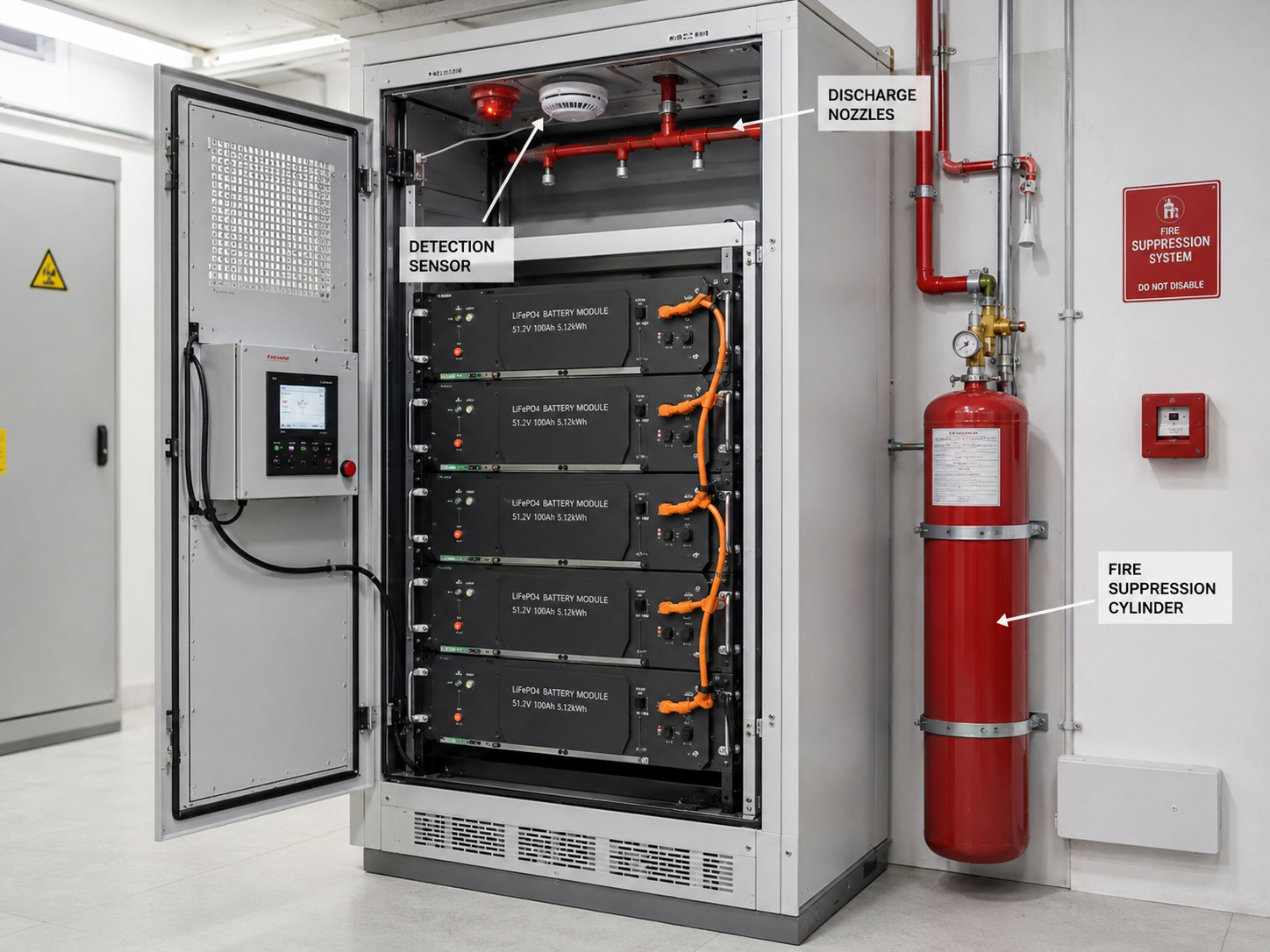
1. Never design storage where temperature can drop below +5°C. 2. Don't trust customer claims about room temperature. Measure with a temperature logger for at least 24 hours. 3. Ensure passive thermal insulation. Non-combustible material (class A2-s1,d0) provides both insulation and fire protection. 4. Plan active heating for long frost periods. A 40–60 W heating mat controlled by a thermostat costs ~€50 and can save a €5,000 storage unit. 5. Check the customer's BMS specification. 6. Design anti-condensation ventilation. 7. Document the handover with temperature measurements and customer responsibility clauses. 8. Educate the customer about winter degradation scenarios. 9. For risky locations — use an external enclosure with controlled climate.
Summary
A well-designed installation is one where the installer sleeps peacefully through January, knowing their storage units are in enclosures maintaining stable temperature regardless of conditions outside. Controlled thermal environment is not an add-on — it's a fundamental requirement.
Solution: PassivX fire-resistant enclosure with passive thermal insulation and optional active heating — the only enclosure that protects batteries from frost, fire, and moisture simultaneously.